

Thailand's Developers Nail 2mm Tile Tolerances — Who's Managing the Other Half of a Property Deal? A TPTP Industry Note
 Last Updated2026.09.28
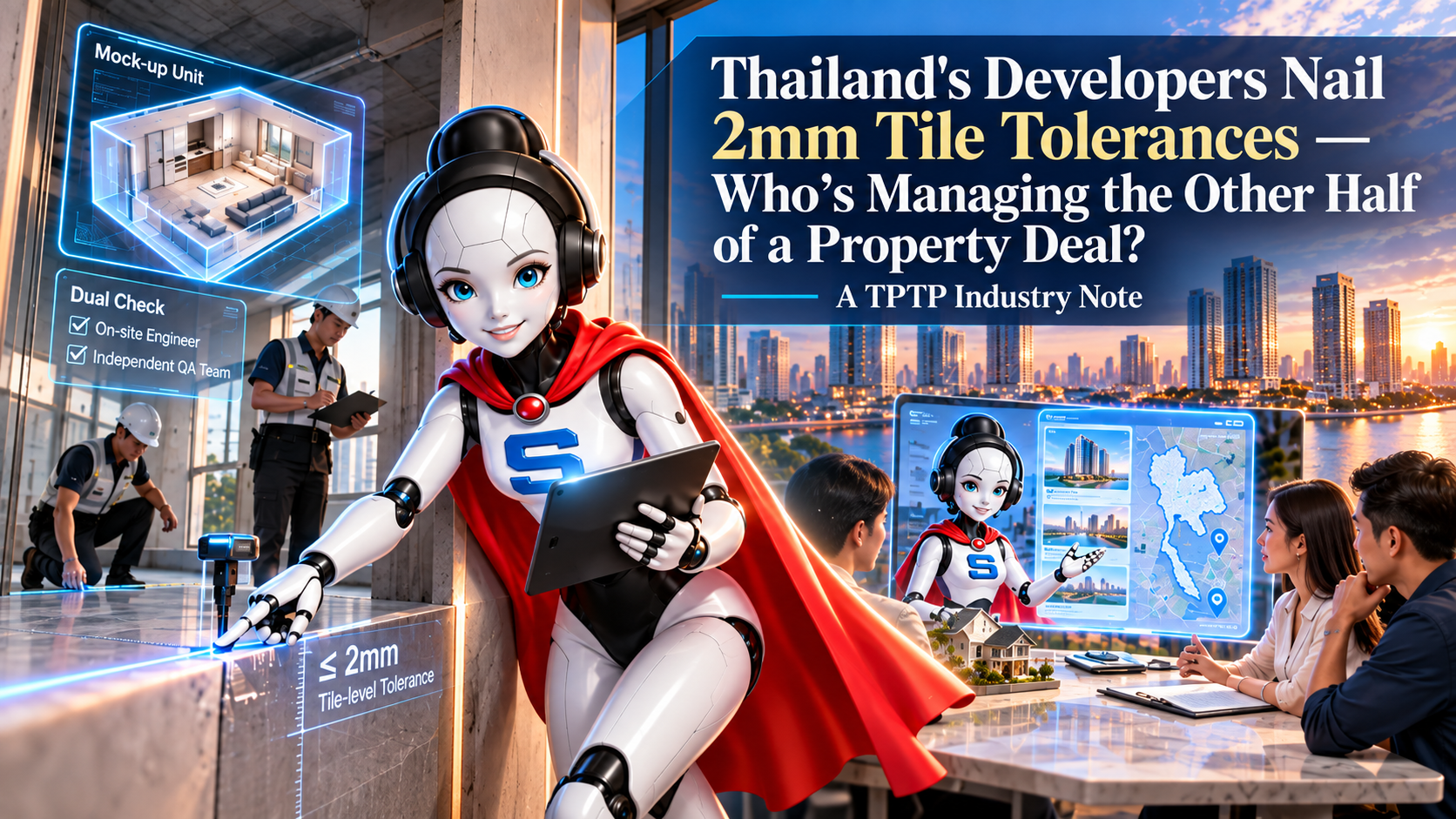
On September 27, 2026, Thai developer AP Thailand told Terra BKK how its "Quality Blueprint" system works in practice: a physical mock-up unit built and tested before each project's main construction begins; a "dual check" process in which on-site engineers and an independent QA team verify the same work against the same standard; quantifiable tolerances, such as a stated limit of no more than 2mm of deviation on tile-level flatness; and the same rigor extended to concealed work like plumbing and wiring, under what the company calls its "EMPOWER LIVING" philosophy. That story is squarely about construction quality — but it points at a question the transaction side of the industry rarely answers with the same precision: once a unit is built well, who verifies the listing is genuine, that an agent can match a buyer to the right property efficiently, and that someone is still accountable once a deal closes? TPTP (Thailand Property Trading Platform), a system already live at agent.stptp.com, positions itself around exactly that second half of the chain — not as a single intermediary, but as a "listings + agents + technology + service + capital" ecosystem.
I. The News Itself: What AP Thailand's Quality Blueprint Actually Describes
According to Terra BKK's September 27, 2026 report, AP Thailand's "Quality Blueprint" runs from design and construction standards through material selection to full-process inspection. A few specific mechanisms stand out: the company builds a physical mock-up unit for each project to test materials and workmanship before formal construction starts; quality checks follow a "dual verification" model, with on-site engineers and an independent QA team separately confirming work against the same standard, rather than leaving sign-off to one party; there are quantifiable "quality tolerance" thresholds — the report cites a tile-level deviation limit of no more than 2mm as an example; and the same discipline extends to hidden systems such as plumbing and electrical work, not just visible finishes. AP Thailand frames all of this under its "EMPOWER LIVING" philosophy.
It's worth being explicit: this piece cites the story as an industry signal, not as a product review or soft endorsement of AP Thailand's projects. What follows is about the broader question the story raises for the rest of the transaction chain.
II. From Build Quality to Transaction Trust: Why a Construction Story Matters Beyond Construction
When a Bangkok developer is already competing on a 2mm tile tolerance, a natural question follows: is there an equally systematic answer for the other half of a property deal — whether listing information is genuine, whether agents and channel partners can match buyers to properties efficiently, and whether anyone manages disputes and after-sales issues once the deal is done? Or does that half still run on "find a property through people, experience, and connections"? Three recurring problems line up closely with that question:
Funding and trust risk — no qualification oversight, low client confidence. Genuine listings sit alongside inaccurate ones, and channel partners vary widely in credentials, which makes it hard for buyers and owners to tell who is actually accountable for a transaction.
Pricing disadvantage — no owned inventory means weaker sourcing prices. A channel partner without access to a large, owned listing pool has structurally weaker negotiating leverage, which shows up as less competitive terms for the client and a slower, more information-asymmetric process.
Missing after-sales support — no dedicated team, disputes and repairs go unmanaged. Many deals are treated as "finished" the moment a contract or handover happens, leaving repair requests, management disputes, and asset issues with no clear owner to follow up.
What these three have in common is that they sit outside "how well the unit was built" — they belong to the transaction and service side, the half of the chain that a pure construction-quality story tends to leave out.
III. TPTP's Answer: Not a Single Intermediary, but a Listings + Agents + Technology + Service + Capital System
TPTP's stated position is that it is "not a single intermediary platform, but a 'listings + agents + technology + service + capital' symbiotic system," connecting owners, developers, landlords, channel partners, agents, and property buyers and renters globally, under the strategic line "Rooted in Thailand, Expanding Globally." The idea is to use genuine listings, transparent rules, AI-driven matching, and back-end service as the foundation — moving Thailand property transactions from "finding a property through people, experience, and connections" to "system-matched, rule-governed, service-closed-loop."
Mapped against the three problems above, TPTP's five platform capabilities read as a systematic response:
| Industry problem | Corresponding TPTP capability |
|---|---|
| Funding/trust risk — no oversight, low confidence | Verifiable listings, which cut down on false information and repeated back-and-forth; clear pricing, commission, and rules, which lowers the decision-making bar for clients |
| Pricing disadvantage — no owned inventory | AI matching between people and properties, improving agent conversion efficiency; clear pricing and rules, making listings and prices more transparent and comparable |
| Missing after-sales support | Transaction, escrow, after-sales, and asset management forming a long-term service chain — folding repairs, disputes, and asset management into the system rather than treating a closed deal as the end |
| (Agent/channel capability itself) | Training, tools, traffic, and physical outposts working together to support execution on the ground |
These five capabilities aren't isolated features — they're meant to function as the "symbiotic system" the brand describes, where listings, agents, technology, service, and capital reinforce each other.
On the trust side specifically, three items from the affiliated brand BigHousekeeper (泰国大管家)'s track record serve as concrete anchors: a compensation-first mechanism unique across Thailand, used to establish trust earlier in a negotiation; a large, owned pool of listings at the tens-of-thousands-of-units scale, which directly answers the "no owned inventory, weaker pricing" problem; and a physical footprint of self-operated experience centers and a headquarters — a tangible presence that mirrors, in its own way, what AP Thailand is doing with mock-up units: quality you can walk into and see, not just a claim on a page.
IV. TPTP Is Already Live: What You Can Actually Do Today
It's worth being explicit that TPTP's system is already live and in use, not a "coming soon" project. The website at agent.stptp.com already includes navigation for exclusive listings, client management, listing management, buying, renting, and property news, under the operating entity Smart Housekeeper Co., Ltd. In practice, that means a buyer or renter can browse listings today, and an agent or channel partner can look at the client- and listing-management tools directly, rather than waiting for a future launch date. Questions along the way can go to the customer service line at 0630915813 or by email to contact@stptp.com.
FAQ
Q1: Is this an ad for AP Thailand?
A: No. The AP Thailand story is used as an industry signal to introduce a broader question about the transaction side of the chain, not as a review or endorsement of AP Thailand's specific projects.
Q2: Is TPTP just another intermediary platform?
A: TPTP describes itself as "not a single intermediary platform, but a listings + agents + technology + service + capital symbiotic system," connecting owners, developers, landlords, channel partners, agents, and global buyers/renters — not a one-sided matchmaking service.
Q3: How does TPTP verify listings are genuine?
A: Verifiable listings is one of the five platform capabilities, aimed at reducing false information and repeated back-and-forth communication; specific verification steps and standards follow TPTP's own official documentation.
Q4: Are pricing and commission rules transparent?
A: The stated direction is "clear pricing, commission, and rules" to lower the decision-making bar for clients; specific rules follow what's shown inside the system and TPTP's official statements — this piece does not cite specific figures.
Q5: Who handles repairs or disputes after a deal closes?
A: That's exactly what the "transaction, escrow, after-sales, and asset management" capability is meant to address — a service chain that continues after the deal, rather than treating closing as the end point; the specific after-sales process follows official documentation.
Q6: What can a buyer or renter actually do on TPTP right now?
A: The website at agent.stptp.com is live, with buying, renting, and property news sections available to browse directly; questions can go to 0630915813 or contact@stptp.com.
Q7: Can agents or channel partners connect with TPTP now?
A: Yes — the system is live, and modules commonly used by agents and channel partners, such as exclusive listings, client management, and listing management, are already in operation under Smart Housekeeper Co., Ltd.; specific partnership details are best confirmed directly with TPTP's customer service team.